

I’ve been away from music for roughly 10 years. I stayed loosely connected through friends, remained emotionally connected through music, and would occasionally pull out my bassoon or sit at the piano to revisit old etudes and pieces. Every now and then I would improvise at the piano, but I never wrote any of it down.
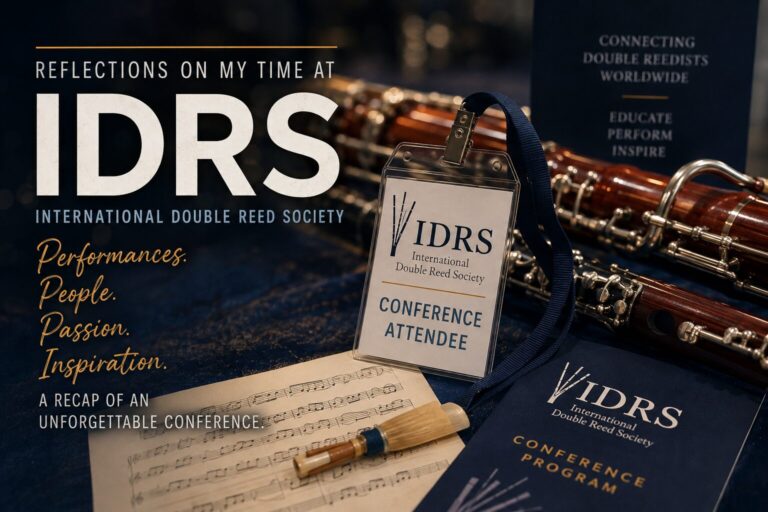
Coming back into the music world a decade later has been incredible. Once I started performing again with the Westerville Concert Band, I began reconnecting with my double reed roots. One of those roots was looking into IDRS again to see how the organization and conference had grown over the years, and I’m so glad I did. When I discovered this year’s conference was being held here in Ohio, I renewed my long-forgotten membership and signed up for the early-bird registration as quickly as I could.
The last music conference I attended was IMEA back in 2006. While I was excited to jump back in headfirst, I was also nervous because (a) I had never attended an IDRS conference before, and (b) I had absolutely no idea what to expect. A lot can change in 20 years, and what I quickly discovered was…a lot had.
I arrived on the first day with enough time to register, grab my conference program and map, and figure out where an old friend and her group were performing. I had spotted her name on the schedule the night before and was surprised to see a clarinetist I knew performing at a double reed conference. It was wonderful to hear Moria Tunison perform again with her woodwind quartet, the Prairie Winds.
Not only was the performance outstanding, but I was fascinated by how the group prepared. While I later learned this has become fairly common among professional chamber ensembles, it was a new concept to me. The members live all across the country. They select repertoire, rehearse their own parts individually, then (at least in this case), gather the day before the performance to rehearse together for several hours before presenting the concert. What a fantastic way to bring together exceptional musicians without letting distance stand in the way of making music.
In addition to the Prairie Winds performance, I attended a fascinating lecture-recital about commissioning new music for historical bassoons. It offered a glimpse into both the opportunities and challenges of writing contemporary music for Baroque instruments. It was a fascinating intersection of history and modern composition.
Later that afternoon I heard one of the few performances during the week featuring a tenoroon. For those unfamiliar with the instrument, the tenoroon is essentially a smaller bassoon designed for players with smaller hands, yet it still boasts an impressive range of roughly two and a half octaves. It worked beautifully in a trio alongside bassoon and contrabassoon. Since there are still relatively few makers producing tenoroons, I found the sound to be somewhat narrow and dated compared to the modern bassoon. I’ll be curious to see how the instrument evolves as more manufacturers begin producing their own versions.
I capped off the evening by attending the conference concert. Each night’s concert featured an eclectic mix of styles, all centered around double reeds, and it quickly became one of my favorite parts of the conference.
One work that especially caught my attention was Towards Eternal Sky, written for bassoon, sheng, and fixed media. The combination of the bassoon and the sheng created some truly captivating timbres, while the fixed media provided subtle atmospheric textures that tied everything together. It was unlike anything I had heard before.
I also thoroughly enjoyed the world premiere of Quartet for Oboe, English Horn, Bassoon, and Piano by Andrew Lewinter, as well as Waves for Bassoon and Harp by Gernot Wolfgang.
My favorite work of the evening—and honestly, one of my favorites from the entire conference—was Father’s Day for oboist (performing on oboe, oboe d’amore, and English horn) and strings by Corey Field.
Before the performance, Corey spoke about his long-standing friendship with oboist Nicholas Daniel and how much he admired Nick’s love for his children. As a father myself, that immediately resonated with me.
The piece tells the story of fatherhood through the changing voices of the three instruments. It begins with the oboe—young, buoyant, energetic, and playful. As the work unfolds, it transitions to the oboe d’amore, representing the way a father softens with age, becoming more understanding and supportive. Finally, it moves to the English horn, symbolizing wisdom, patience, and watching your own children grow into parents themselves, while still holding onto the warmth and sweetness of youth.
It was an absolutely beautiful work, and hearing Nicholas Daniel perform it was nothing short of inspiring. Nicholas traveled from England specifically to perform the piece that Corey had written for him, and I think that says so much about the relationship between composers and performers. As composers, we can write music for anyone, but when we choose to write for a specific musician, hearing that person bring the work to life carries a significance that is difficult to describe.
One day down, and four more to go.
I’ll continue sharing my experiences from each day of the conference—not only for anyone interested in following along, but also as a way to preserve these memories for myself years down the road.