
For Wind Ensemble
Listen:
Program Notes
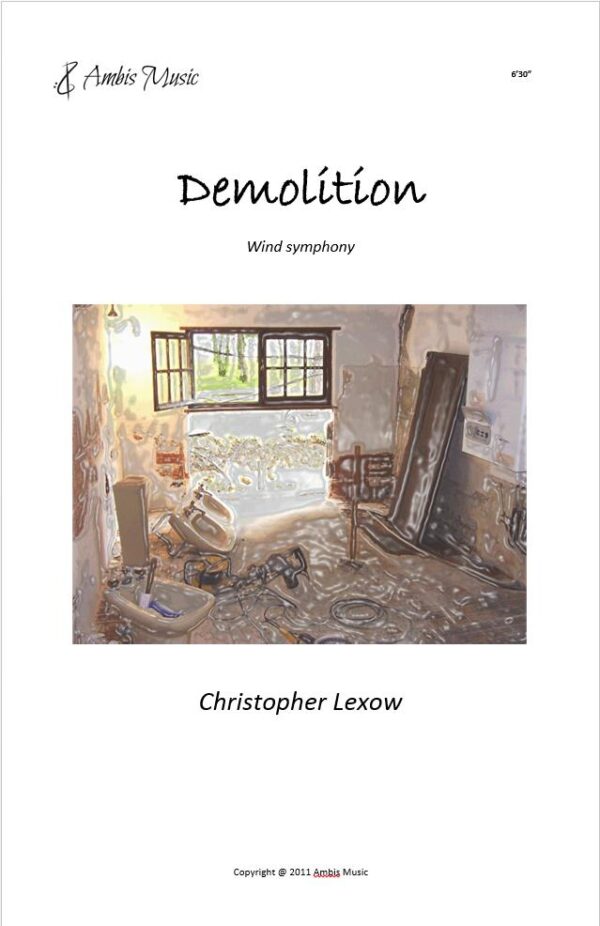
In October of 2010 while walking through Eastern’s campus I had been searching for inspiration to start writing my next piece. I had been pondering this for a few weeks after finishing Iridescent Winds and couldn’t decide what I wanted to begin working on. As I walked home and kicked the autumn-colored leaves around my thoughts somehow made it to John Mackey. Then I started thinking, what would John do? It had been a while since I had written just a wind band piece, so that was the answer to one question. My next question was, about what? John had recently been posting on his site about the latest renovations happening at his house in Austin. One of their bathrooms was the last room in their house that was to be renovated. Bingo! I practically ran the rest of the way home, sent John an email, and began working on the piece immediately.
Demolition, simply stated, is the destruction of John Mackey’s bathroom. From loosening screws and pounding out boards, to water spraying everywhere and knocking down a wall, Demolition takes the listeners and musicians on a chaotic musical journey of destruction. The repair man is called in, takes out his screw driver and begins to loosen the hinges on the door. After working hard disassembling, it’s time for a lunch break. From here on out its mass destruction until the wall is brought down. Once the demolition is finished, he walks out dropping his last screw on the floor.
Performance Notes
Difficulty & Ensemble Considerations
Demolition is written at approximately a Grade 5 level and is intended for advanced wind ensembles. The work demands strong rhythmic independence, technical facility, endurance, and confident ensemble precision across a wide dynamic range. Its exposed writing, rapid changes in texture and character, and extensive percussion requirements call for mature players who can maintain clarity and control while embracing the theatrical nature of the work. Directors should also consider the additional rehearsal and logistical demands created by the nontraditional percussion effects and staging elements described below.
Mallets
- Bass drum mallets should be articulate but not too dry. I would prefer a medium-medium hard mallet be used depending on the performance venue.
- Marimba mallets need to be around a medium to create an articulate but semi-warm sound.
- Timpani mallets should be around a medium-hard to hard to bring out articulation.
- Cymbal and Tam-Tam mallets all need to be around a medium-soft for good articulation to enhance accents, but soft enough to roll the cymbals without the sound of articulation.
Cymbals
- Suspended cymbal: 16”
- Trash Crash cymbal: 16” (this can be substituted with a 10”splash cymbal)
- China cymbal: 14-16”
Special Percussion
- Break Glass – miscellaneous glass such as glasses and dishes should be broken into the bottom of a large trash can, something like 32 gallon that has a lot of “boom”. Sound should be made by raising the trash can off the surface and slamming the bottom flat onto the floor. A lid may be used to deflect flying shards of glass if needed. Please don’t allow anyone to get hurt.
- Electric Saw – Use your resources. I have found that using a circular saw (with no blade please!) creates the best sound. If your performance venue allows sound to carry too much over the band, try putting the saw under a blanket or towel to muffle.
- Hammer with 2×4 – Exactly as it sounds. Some type of metal hammer needs to be used. This can be a mallet, claw hammer, or something else. Sound is made by simply smacking the hammer head on the wood to get a real “construction-like” sound.
Staging & Musical Effects
- One thought I had about this piece while writing it was making the “lunch-break” section at bar 70 a little more comical. In typical Wind Symphony settings that I have been a part of, the brass are usually along the back of the ensemble while the winds occupy the front. I felt it would be amusing to the audience and ensemble, to allow the winds to have sandwiches, drink jugs, and other artifacts that you might see on a construction site, and eat or at least pretend to eat and relax during the “lunch-break” section. I’ll leave this up to the director’s discretion whether or not to actually do it, however I do believe that visual effects help bring out the musical attributes.
- The Trombones are meant to musically represent a power drill. The D3 to D4 that is written is just a guide for the sound that I am looking for. Trombones are to start as low as possible and slide up to the D4, following the rhythmic and pitches given. Rearticulating may be used if necessary approaching the D4 at the end of the slide. This same concept applies as well later on when the minor 3rd is added above.
Reviews
There are no reviews yet.