

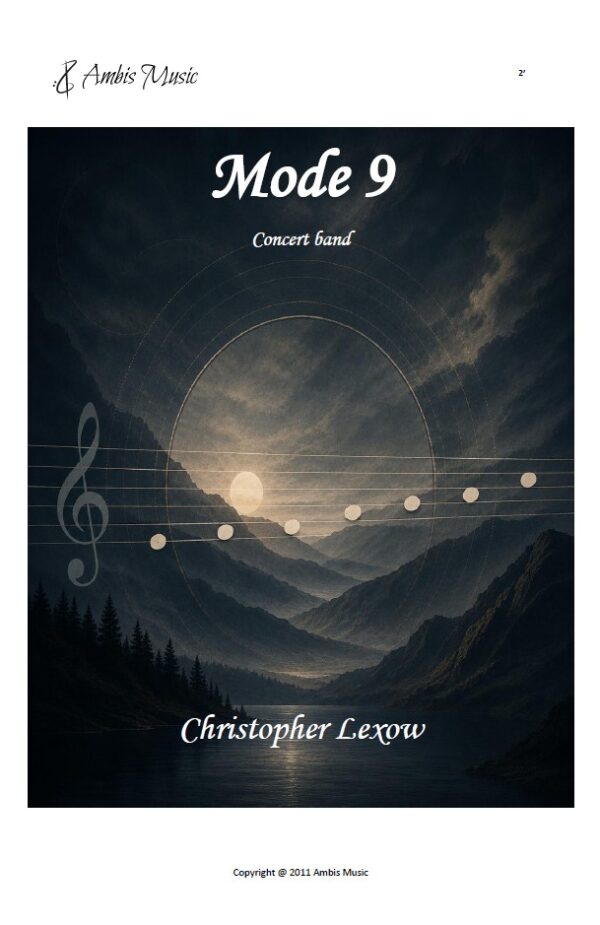
For Concert Band
Listen:
Program Notes
Mode 9 was written simply to be an opener. It begins with the ensemble tuning to two pitches, first, the brass to a Bb, and then the woodwinds to an A. While the woodwinds are tuning, the piece immediately takes off at a quick pace, combining a moving beat with an active bass line in A minor.
The title and key both come from 1547, when a Swiss theorist by the name of Henricus Glareanus published the Dodecachordon in which he solidified the concept of church modes, and added four additional modes to the original eight. One of the modes, mode 9, was designated as the Aeolian mode. I thought this to be a very fitting title as the piece is written entirely in the Aeolian mode.
Performance Notes
Difficulty & Ensemble Considerations
Mode 9 is written at approximately a Grade 3 level and is intended for developing intermediate concert bands. The primary challenges are maintaining rhythmic precision and articulation at a brisk tempo, balancing the active accompaniment figures across the ensemble, and establishing a confident sense of pulse immediately following the opening tuning sequence. The work provides an opportunity to reinforce ensemble timing, articulation, balance, and rhythmic independence without requiring individual technique beyond the intended Grade 3 level.
Opening Tuning Sequence
The first two measures are intended to function as tuning measures, creating the impression that the ensemble is tuning as usual before the performance begins. The brass should tune first to concert B♭, followed by the woodwinds on concert A. While the woodwinds are tuning, the conductor should already be on the podium establishing the pulse. Measure 3 should emerge directly from the tuning note without a break. During the tuning sequence, players should behave as they normally would during a pre-rehearsal warm-up, including casual playing or “diddling” as appropriate.
Mallet Selection
A somewhat drier mallet sound is recommended for this piece; approximately medium-hard should work well, depending on the performance venue and instruments. The mallet percussion should speak with clarity and articulation rather than functioning primarily as a coloristic effect.
Reviews
There are no reviews yet.